
AIDeveloper44 logoaideveloper44home of every ai dev release
← all tools
NVIDIA·May 31, 2026·open source

NVIDIA Cosmos 3

NVIDIA Cosmos 3 is a frontier open-source physical AI foundation model that unifies physical reasoning, world generation, and action generation in a single model using…
Agentic AIAI/Dev InfrastructureOpen Source
Visit WebsiteDocsPlayground
on the blogNVIDIA Cosmos 3: The World's First Fully Open Omnimodel for Physical AI 5 min

What is NVIDIA Cosmos 3?

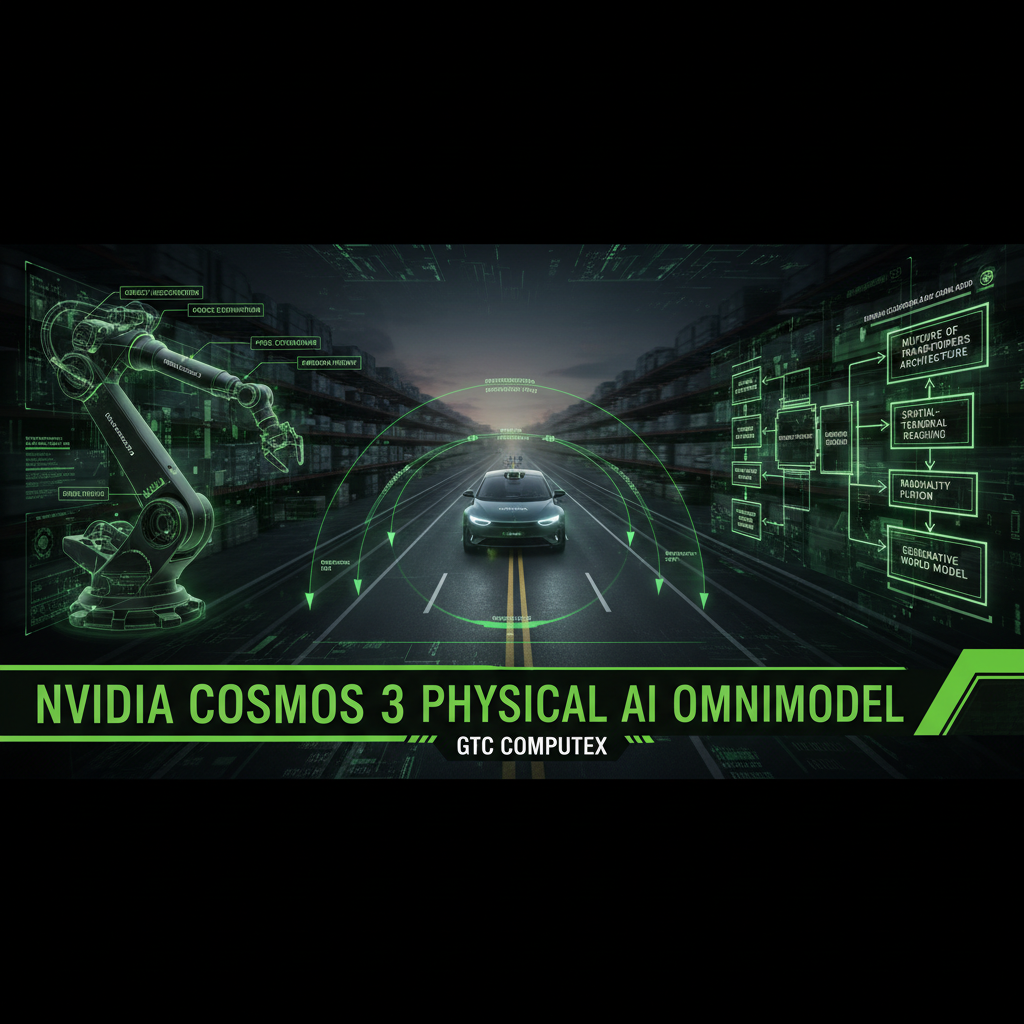
NVIDIA Cosmos 3 is a frontier open-source physical AI foundation model that unifies physical reasoning, world generation, and action generation in a single model using a Mixture-of-Transformers (MoT) architecture. It combines a Reasoner tower (VLM for understanding) and a Generator tower (diffusion-based video/action output), eliminating the need for multiple separate models. Available in two sizes — Cosmos 3 Nano (8B) and Cosmos 3 Super (32B) — with fully open model weights, training scripts, deployment tools, and six synthetic datasets on Hugging Face.

NVIDIA's open-source physical AI foundation model unifying reasoning, world generation, and action generation in one model — SOTA on PAIBench, R-Bench, and Physics-IQ.

NVIDIA Cosmos 3 fits into the Agentic AI and AI/Dev Infrastructure categories. It was released on May 31, 2026.

NVIDIA Cosmos 3 is open source. Teams typically use it for workflow orchestration, model serving, browser automation and hardware acceleration, with domain-specific use in Customer support, Enterprise, Finance ops and Healthcare.

Who NVIDIA Cosmos 3 is for

Teams and individual developers working in Agentic AI and AI/Dev Infrastructure.

AI engineers

Build, orchestrate and debug multi-step agents

ML and MLOps engineers

Serve, scale and monitor AI workloads

Automation engineers

Replace manual multi-step workflows with tool-calling agents

Platform engineers

Run AI infrastructure reliably and cost-efficiently

Product teams

Prototype and ship agent-powered features

Researchers

Run experiments on GPUs, TPUs or other accelerators

Key features

01Unified Mixture-of-Transformers (MoT) architecture — Cosmos 3 combines a Reasoner tower (autoregressive VLM that interprets images, video, and text to understand motion and physical context) with a Generator tower (diffusion-based process for physics-aware video and action output); the reasoner can run independently, while the generator activates both towers — eliminating multi-model orchestration and simplifying physical AI development pipelines
02Two model sizes for every deployment scenario — Cosmos 3 Nano (8B parameters) is optimized for workstation-grade inference on NVIDIA RTX PRO 6000 for real-time robotics; Cosmos 3 Super (32B parameters) targets datacenter Hopper/Blackwell GPUs for large-scale synthetic data generation; both available as NVIDIA NIM microservices for production-ready deployment without manual infra tuning
03Open-source SOTA across physical AI benchmarks — leads on PAIBench-G, R-Bench, Physics-IQ, RoboLab, VANTAGE-Bench (reasoning), and Artificial Analysis Text-to-Image and Image-to-Video leaderboards; ships with fully open training recipes (SFT + action post-training), six synthetic datasets covering robotics/AV/warehouses/physics/human motion, and the new Cosmos HUE evaluation framework for rigorous video generation quality assessment

NVIDIA Cosmos 3 use cases

Horizontal · cross-industry

Workflow orchestrationMulti-step tool-calling agents with planning, retries and state
Model servingHigh-throughput inference with batching and KV/prefix caching
Browser automationAgents that navigate, fill forms and extract data from web apps

Vertical · domain-specific

Customer supportTicket triage agents connected to CRM and knowledge-base APIs
EnterpriseSelf-hosted inference in a VPC to keep data in-house
Finance opsInvoice reconciliation against ERP data with anomaly flags